
Sow your own
 by Mark Evans
Every packet of seed you buy is someone else’s harvest, sold back to you. Saving your own seed is cheaper, more self-sufficient, and satisfying, though it takes more than scooping seeds from a ripe tomato and hoping for the best.
Not every seed grows true to its parent. Open pollinated varieties, sometimes labelled heirloom, will breed true provided they haven’t crossed with another compatible variety. Hybrids, marked F1 on the packet, are a deliberate cross, bred for a particular trait, vigour, disease resistance, and uniform fruit. F1 seeds germinate fine, but the resulting plants won’t reliably reproduce those traits, the genetics simply reshuffle each generation.
That caveat matters more for some crops than others. Pumpkins and squash cross readily with nearby compatible varieties, so a normal fruit this year can hide seed that grows into something different next season. Corn is even more promiscuous, and brassicas can be tricky too. Tomatoes, peas and beans are far more forgiving since they largely pollinate themselves.
Technique depends on the seed, and seed maturity isn’t eating maturity, the biggest trap for beginners. A cucumber left for seed must swell and turn yellow, well past salad stage; bean pods stay until dry and brittle; lettuce must bolt and flower before it sets anything worth collecting. Dry seeded crops like these are simplest, dried on the plant, then stripped, threshed and stored.
Tomatoes are the classic case for something wetter. Scoop the pulp and seeds into a jar with water and ferment for a few days. This cleans the seed and can reduce some seed-borne diseases. Not every wet-seeded crop needs this though; capsicum seed can simply be cleaned and dried.
 Some crops test your patience further. Carrots, beetroot, onions and several brassicas are biennials, setting seed only in their second year; so, a first-year carrot won’t normally flower.
Storage matters too. Seeds kept cool, dark and dry will outlast anything left in a hot shed or damp drawer. Once thoroughly dry, a labelled envelope, noting variety and date, tucked into a jar in the fridge will see most vegetable seeds through several seasons.
Beyond the savings, saved seeds can become locally adapted. Avoid saving from diseased plants, and favour the healthiest and most productive, whichever thrived in your own soil, rainfall and run of pests. Repeated selection over a few generations can shift a population toward those traits. For some plants we skip the effort and let them reseed themselves, keeping us in a fairly reliable supply of rocket, parsley, coriander, dill and lettuce without deliberate saving.
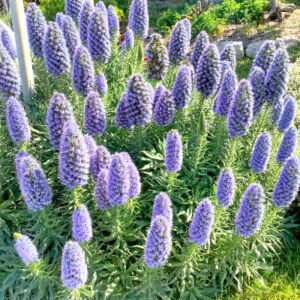
Meanwhile, around the town gardens the spring flush is well underway. Lavender, pelargoniums and daisies are sparkling, azaleas are aflush, and clusters of orange Clivia miniata (Clivia) brighten the shadier corners Wisteria sinensis (Wisteria) hangs in perfumed curtains, while the tall blue spikes of Echium candicans (Pride of Madeira) sway above their grey green foliage.
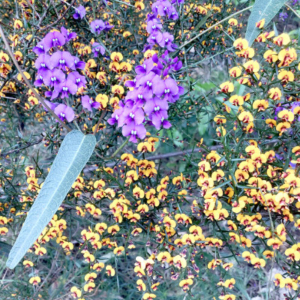 Along the roadsides around the Triangle, the native climber Hardenbergia violacea (Purple Coral Pea) is producing its mass of small purple pea shaped flowers, joined by the golden blooms of the Egg and Bacon bushes.
October brings the widest planting window of the year. Get in beans, capsicum and chilli, corn, cucumber, eggplant, melons, pumpkins, tomato and zucchini, while continuing beetroot, carrot, celery, lettuce, onions, peas, potatoes and silverbeet.
Got a gardening question, plant mystery or pest problem? Drop us a line at gardening@thetriangle.org.au. We’d love to hear from you.
Happy Growing.
Photo above right: Wisteria sinensis (Wisteria)