Wrong place, wrong plant
 By Mark Evans
There’s no such thing as a weed, botanically speaking, just a plant growing where we don’t want it. Years ago, we removed a Lagerstroemia indica (crepe myrtle) from our garden. It had been lovely in its day, but it had to go. The rootstock never got the memo and sends up suckers through our beds – that decision we made then is now the thing we’re fighting to keep out.
Wrong place isn’t always about taste, sometimes it’s geography. Every plant has a natural range outside of which it cannot survive. Andropogon gayanus (Gamba grass), one of the tropical north’s worst weeds, is killed outright by frost here. The reverse holds too: Rubus fruticosus (blackberry), a declared weed across temperate Australia, is essentially absent from the tropical Northern Territory, lacking the winter chill it needs. Climate draws a boundary as firmly as any fence.
Officially, weeds are ranked by the damage they do. Thirty-two are Weeds of National Significance, while NSW’s Biosecurity Act sorts local offenders into Prohibited Matter, State Priority and Regional Priority Weeds, replacing the old noxious weeds label that operated until 2017.
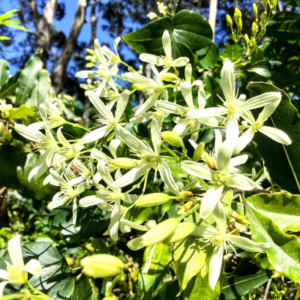
Clematis glycinoides (headache vine)
Every garden escapee started as somebody’s deliberate choice, and Lantana camara (lantana) is the classic case. Arriving in Adelaide in 1841 as a handsome ornamental shrub, within twenty years it had leapt garden fences. It now blankets four million hectares of the east coast, reaching as far south as Mount Dromedary/Gulaga, practically our doorstep.
Not every weed arrives from overseas. Pittosporum undulatum (sweet pittosporum) is a true local native, fire sensitive and once confined to sheltered gullies. With fire now less frequent, it has spread well beyond them into surrounding forest and gardens, carried by birds feasting on its berries. A changed landscape can turn a native into a weed just as easily as a ship full of ornamentals once did.
So why does a plant turn weedy? Prolific seeding is one reason: our own Tagetes lemmonii (Mexican marigold) flowers beautifully but seeds relentlessly. Its seeds don’t travel far though, so we have decided to retain it and pull out any stray seedlings, a reminder that keeping weeds in check is part of the gardener’s job description. Effective dispersal is another mechanism, as lantana and pittosporum demonstrate, and a plant with no natural checks left can just keep going.
Whatever the mechanism, the response stays the same: pull small weeds before they flower and seed, since one plant left unchecked can produce thousands more, hence the old warning that one year’s seeding means seven years’ weeding. Keep bare soil mulched too, an open bed is an invitation, though nothing stops a stray seed drifting in on the wind or dropping from a passing bird.
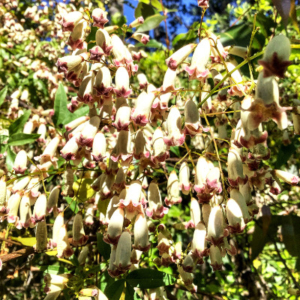
Pandorea pandorana (Wonga Wonga vine)
Meanwhile, around the town gardens the Prunus spp. (ornamental cherries and plums) are opening into blossom, joined by deciduous magnolias and the perfumed Jasminum polyanthum (jasmine).
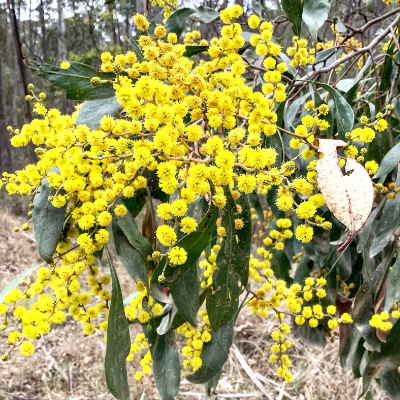
With September marking National Wattle Day, roadside Acacia species are lighting up gold al1 cross the Triangle, including the locally endemic Acacia pedina (Bermagui Golden Wattle). Look too for delicate white drapes in smaller trees, either Clematis glycinoides (headache vine) or Pandorea pandorana (Wonga Wonga vine), a closer look will tell them apart.
In the vegie garden, sow root crops such as beetroot, carrots and swedes, plus celery. Otherwise continue with onions, peas, potatoes and silverbeet, and get ready for October’s main planting rush.
Got a gardening question, plant mystery or pest problem? Drop us a line at gardening@thetriangle.org.au. We’d love to hear from you.
Photo above right: Acacia pedina (Bermagui Golden Wattle)