Proteus would be proud
 by Mark Evans
Proteus, the Greek sea god who could change shape at will, gave his name to the plant family Proteaceae, via the genus Protea. When Carl Linnaeus encountered plants that varied wildly in flower, leaf and habit, he knew exactly what to call them.
The Proteaceae family now includes around 83 genera and some 1,700 species. Australia is the great stronghold, holding roughly half the genera and the majority of species, including our iconic banksias, grevilleas and hakeas. Close relatives thrive in South Africa (Protea, Leucadendron, Leucospermum) and South America (Embothrium, Gevuina). Their scattered distribution is a living record of Gondwana, the ancient southern supercontinent that began breaking apart more than 100 million years ago.
What we casually call a flower on a banksia or grevillea is often a spectacular inflorescence packed with hundreds, sometimes thousands, of tiny individual florets. This clever packaging creates one bold, nectar-rich target instead of hundreds of small ones, making it almost impossible for pollinators to ignore. Watch a honeyeater working through a grevillea and you’re witnessing a symbiotic partnership refined over millions of years.
A defining trait of many proteaceous plants is their mastery of poor soils. They produce specialised proteoid (cluster) roots just below the surface, dense mats of rootlets that exude acids and enzymes to unlock scarce phosphorus. The trade-off is extreme sensitivity to added phosphorus; ordinary garden fertiliser can quickly poison them. In the garden, the lesson is clear: choose a sunny, well-drained spot, keep feeding to a minimum, and resist the urge to enrich the soil. These plants evolved on lean ground and perform best when left to do what they do naturally.
Few people realise that the delicious macadamia nut also belongs to this ancient family, yet another shape-shifter from Gondwana.
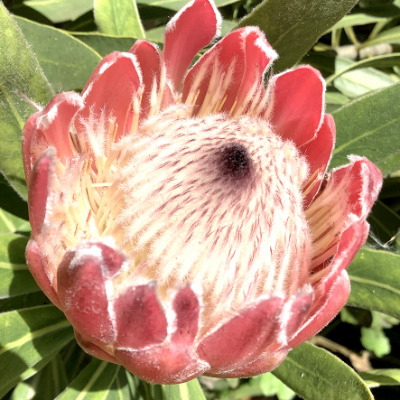
For all their changing forms, Proteaceae follow refreshingly simple rules. Give them the lean conditions they love, and they will reward you with striking beauty and remarkable resilience. (The Protea in the photo above is stunning.)
Meanwhile, the town gardens are putting on their autumn show. Right now, the tibouchinas are stealing the spotlight. Every garden should have at least one, as they come in sizes to suit almost any space.
This is also the perfect time to plan ahead for winter colour. Pop in a few punnets of pansies, violas, primulas or polyanthus to brighten the colder months ahead.
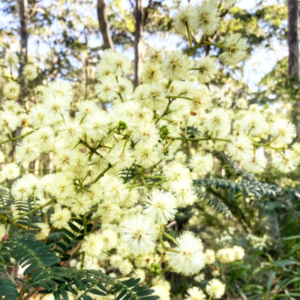
Acacia terminalis
Out in the wild, look for the first yellow dots appearing at head height along roadsides around the Triangle. Acacia terminalis (Sunshine Wattle) is beginning to bloom, one of the few wattles that flowers through the cooler weather.
In the vegie patch, the first peas and snow peas should be ready. Keep the harvests coming with successive sowings. Now’s also the ideal time to plant broad beans, lettuce and alliums such as onions, garlic, leeks and eschalots.
Got a gardening question, plant mystery or pest problem? Drop me a line at gardening@thetriangle.org.au. We’d love to hear from you.
Happy growing!