Threatened bats found at Cuttagee Bridge
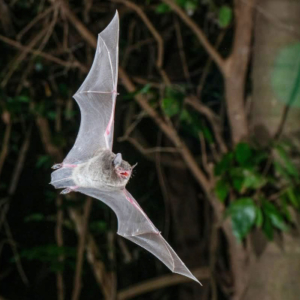 The Restoration of Cuttagee Bridge Group is calling for a full Environmental Impact Statement (EIS) after it identified the Southern Myotis bats at the bridge. Also known as the Fishing Bat, the microbat is listed as vulnerable and protected by legislation.
Group member Stuart Meagher monitored the bridge area with his thermal imaging and infra-red equipment over a two-month period. He sent his footage to Dr Anna McConville, an ecologist who runs a company called Echo Ecology and Surveying on the North Coast.
In her letter, she said Cuttagee Bridge appeared to have suitable roosting and breeding habitat for Southern Myotis and that Stuart’s footage showed the bats foraging nearby and activity from multiple bats near the bridge structure.
The group is now calling on Bega Valley Shire Council (BVSC), Member for Bega Dr Michael Holland and NSW Roads and Regional Transport Minister Jenny Aitchison to insist on an EIS.
Stuart said the Review of Environmental Factors (REF) being conducted for the bridge project was superficial and lacked details that councillors needed to make informed decisions about the project.
‘Our group has no confidence in an REF to address the serious impacts likely to occur on the environment, biodiversity, fisheries, tourism, community safety and cultural heritage,’ he said.
In February 2026 the group asked Dr Holland for permission and about $3200 funding for a professionally prepared Microbat Survey. Dr Holland forwarded the request to the Environment Minister Penny Sharpe, but there was no response.
Council’s website says that an EIS is not required and that an REF is the appropriate and legislated pathway for the Cuttagee Bridge project. ‘An REF is inadequate for the sensitive environment in which the bridge is situated,’ Stuart said.
Marion Williams
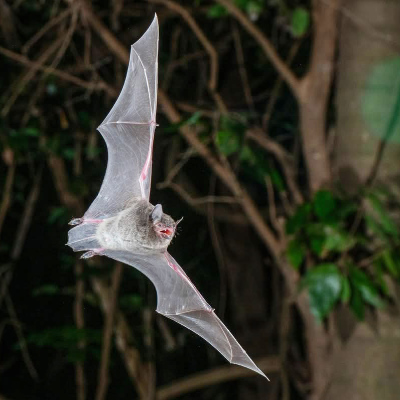
Photo above right: the Southern Myotis bat
Calling curious naturalists, big or small, around the region
A huge number of bat species world-wide are known as microbats. Most microbats are insectivorous but there is one Australian species, Myotis macropus, that has a more diverse diet and an unusual way of acquiring food.
There is a lot of information contained within its scientific name, Myotis macrocarpus – this translates as mouse-eared big foot. And, indeed, it has small mouse-like ears, and those almost transparent ears are sensitive to the smallest sounds in its environment. And big foot? For a very small animal (63 mm long with a 28 mm wide wing-span and weighing a mere 15 grams) it does have outsized feet. Those outsized feet are the next clue to a very unusual capability. Their feet, with long, hairy, distinctly separate toes finishing in long, curved claws, are used for fishing.
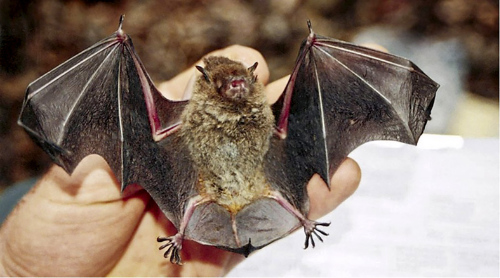
They fly above a body of water, trailing their claws along the surface of the water to scoop up prey – aquatic insects and tiny fish that they eat as they fly. Because of this specialised diet, they are never found far from permanent water.
Myotis macropus can be found from the far north-western corner of Western Australia right around the eastern Australian coast to South Australia, and even up some of our larger river systems. They live in colonies that roost in a wide variety of places such as caves and tree hollows, but they can also utilise structures such as tunnels, mines and the undersides of bridges.
It is thought that the old Cuttagee Bridge may have a colony of these bats. If you sit still at sunset, you may be lucky enough to see some of these tiny animals flying and swooping above the water as they hunt in the twilight.
Angela Marshall