When the shears are sharp
 by Mark Evans
Gardening columnists like to hand out rules. Prune here, plant then, wait for this, avoid that. Advice pages tend to work that way because readers like certainty. But too many rules can make gardening sound intimidating, so it may come as a relief, or an annoyance, to hear that many of those rules are really just guidelines.
Of course, some rules exist for good reason. Tomatoes won’t grow in winter, and a shade-loving plant won’t thrive in full sun. Temperature and light still have the final say. Beyond those natural limits, though, plants are far more adaptable than we sometimes assume.
Take pruning. Gardeners often worry about cutting into one-year or two-year wood or finding the perfect outward-facing bud. That’s all well and good in theory. But sometimes the job isn’t botanical, it’s practical. A shrub grows over the fence, blocks a path or leans into the driveway. Cutting it back now may be more useful than waiting for the perfect moment to prune it neatly.
And if something isn’t pruned one year, or is pruned at the wrong time, the plant will simply grow a little differently and there will be another chance next season. Plants are remarkably forgiving.
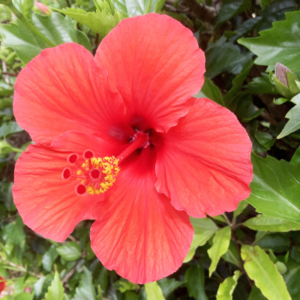
Hibiscus
In the real world, sometimes there isn’t time to get every gardening job done when the calendar says it should be. The weeds, the pruning and the planting often happen, not when the books suggest, but when the gardener finally has a spare hour. And just because peas are usually sown from March to May doesn’t mean you can’t try them in February or June and see what happens.
Gardening involves a lot of trial and error. Some plants might need to be moved two or three times before you finally find the spot where they are happiest. And even experienced gardeners lose plants from time to time. In gardening, as in life, it’s better to have planted and lost than never to have planted at all.
Most gardening success is learned by doing, and doing inevitably includes making mistakes. The old saying that the best time to prune is when the shears are sharp isn’t a rejection of knowledge, it’s reassurance. A slightly mistimed job is usually better than a job never attempted.
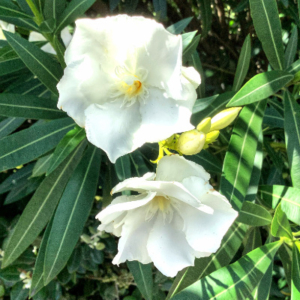
Nerium oleander
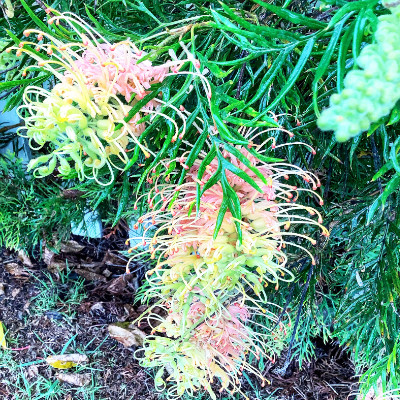
Meanwhile, the town gardens are buzzing with colour. Nerium oleander (oleander) keeps stealing the spotlight, joined by Hibiscus spp. and Magnolia grandiflora ‘Little Gem’. Grevillea ‘Peaches and Cream’ continues to flower generously. The tibouchinas are kicking off their purple reign, while the earliest sasanqua camellias are starting to strut their stuff.
In the veggie patch this month, we’re sticking with peas. Keep sowing them. Come Anzac Day, it’s traditional to plant garlic cloves. Onions are next. Fresh-picked onions are a revelation, rivalling the gap between homegrown and store-bought tomatoes. Add leeks and shallots too, leftover store-bought shallots will grow happily if popped straight into the soil. Winter brassicas like broccoli, cauliflower and kale are still a go, along with swedes and turnips. Keep lettuce and silverbeet coming and, in frost-free spots, keep sowing carrots.
Lastly, got a gardening question, plant or pest mystery, or a comment? Drop us a line at gardening@thetriangle.org.au and we’ll do our best to help.
Happy growing!
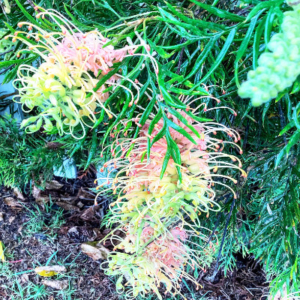
Photo top right: Grevillea ‘Peaches and Cream’.