The other type of water
 As summer ends, gardeners become very aware of how much water they have used just to keep plants alive. At this time of year, water is usually seen purely as a necessity, applied carefully and often anxiously. Yet water plays another role in gardens that is equally important.
Since people first shaped land into gardens rather than fields, water has been held, channeled and reflected for reasons far beyond plant survival. Beyond its essential role for plants, water also shapes space, engages the senses and supports ecology. It influences how a garden feels, functions and connects with other living creatures.
A water feature, whether a pond, basin, bowl or small fountain, transforms the experience of a space. It reflects light and sky, slows movement through the garden and provides a focal point that plants alone often cannot match. Even still water brings depth and stillness. Moving water adds gentle sound and softens hard edges. Simply watching or listening to water has a calming, therapeutic effect.
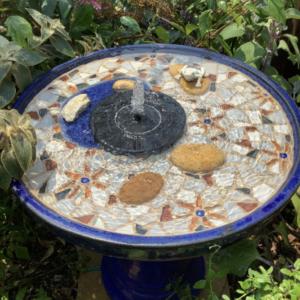
Bird bath with floating solar fountain
Aquatic gardens are layered environments. Plants grow at different depths, submerged, floating and emergent, each helping to keep the water clear and healthy while creating habitat. Birds drink and bathe. Frogs breed. Lizards and insects use the edges. Fish, when present, help control mosquitoes. Size is not critical. Even a single sealed pot with aquatic plants can introduce reflection, movement and wildlife into a small space.
Of course, permanent water brings responsibilities, especially with regards to young children. In New South Wales, the Swimming Pools Act 1992 and Regulation 2018 define a swimming pool as any structure or excavation deeper than 300 mm intended for swimming, wading or paddling. A pond designed solely as an ornamental feature or fishpond is, therefore, not legally required to have a child-resistant barrier fence. Still, risks can be reduced by using mesh covers just below the surface, or by using raised containers or sealed above-ground pots instead of open excavations.
In this light, water becomes more than something poured onto the garden to sustain our plants. It becomes a true design element, like pathways or borders, permanent rather than temporary, held rather than consumed, valued for form as much as function. This is the other type of water.
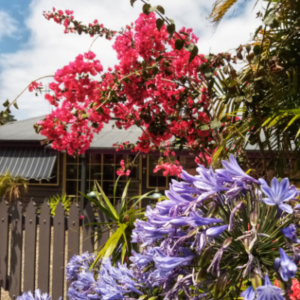
Bouganvillea and agapanthus blooms
Meanwhile, around the towns we have seen some pretty special agapanthus displays over summer, but don’t forget to deadhead the spent flowers now to stop seed spread. The bougainvillea are stunning at this time of year and to keep this dry-tolerant, scrambling, thorny devil tamed, prune it back after flowering and chop back any aggressive rogue shoots as they appear. A final shout out to all the hibiscus currently flowering. These three plants alone brighten up any late summer garden.
Ironically the warmest month in the veggie garden is the time to start planning for the coldest months, so get sowing seeds of broccoli, Brussels sprouts, celery, cauliflower, cabbage and leeks. Round out the soup season garden with some root vegetables such as beetroot, carrots, parsnips and turnips, and keep the leafy greens coming with lettuce, rocket, silver beet and kale.
Finally, if you have any comments, gardening questions or plant or pest identification problems, please send them through to gardening@thetriangle.org.au and I will endeavour to help.
Happy growing.
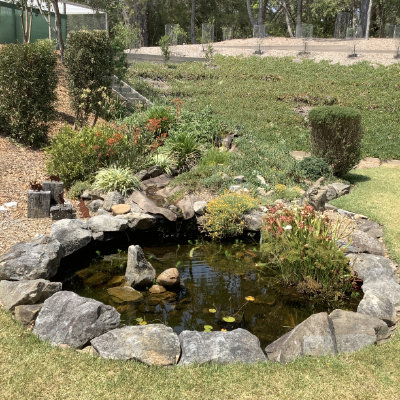
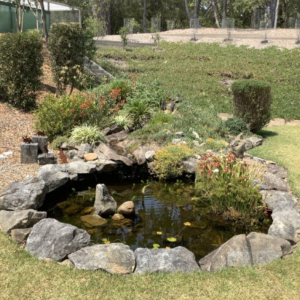
Photo top right: Cascading pond with plants
Mark Evans