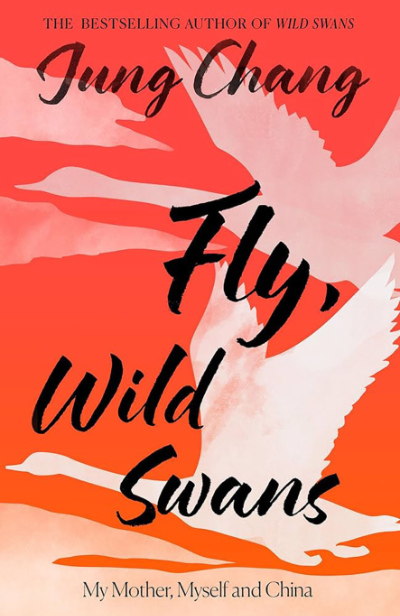
Fly, Wild Swans
 Fly, Wild Swans
Jung Chang
Reviewed by Wendy Tucker
This is the long-awaited sequel to Wild Swans, published in 1991 to worldwide acclaim. Wild Swans told the story of three generations of Chinese women, Chang’s grandmother, her mother and herself and interwove the modern history of China into these very personal memoirs. This was the first insight that most of the West had into the cruelty, terror and insanity of China under Mao through a personal family story. It became the most popular, nonfiction book in history, selling 15 million copies and translated into 40 languages. It was and is banned in China.
A sequel to this important and loved book is a big ask. Fly, Wild Swans was published late in 2025 and returns to the story of the Chang family, beginning where Wild Swans ended in 1978.
The first two chapters retell some parts of Wild Swans with added details to reorientate earlier readers and to inform new readers. Chang then begins the account of her life outside China, beginning with her arrival in London as a heavily supervised and watched university student, dressed in a Mao suit and feeling as if she had ‘… landed on Mars’. We follow her adaptation to the West, her visits to China and her family, the responses to her book’s success and its impact on family and friends.
Again, Chang successfully interweaves her and her family’s personal lives, achievements and problems with China’s. As China opens up under Deng Xiaoping and private ownership, money-making and prosperity become the new normal, Chang is able to travel freely in China. Previously fearful, old CCP officials and former Red Guards feel free to open up to Chang as she conducts hundreds of interviews while she prepares to write a biography of Mao. Many new and once secret stories are told. Chang’s stories of marriage, cancer and family relationships continue in a personal and intimate way. This gift of telling history through the personal is Chang’s gift to the reader.
Chairman Xi’s rise to power in 2012 has a direct impact on Chang. It was increasingly difficult for her to obtain a visa to travel to China to visit her beloved and aging mother. Her last visit was in 2018, the year Xi announced himself as permanent leader and she felt ‘… the ghost of Mao hovering’.
To Chang’s great grief she could not visit her dying mother. Her mother died in 2024 with her last words by telephone to her daughter were, ‘Don’t come back for this’.
I don’t think this sequel is as affecting as the first, but we know so much more about China now. Still, I devoured it in two sittings.
It is primarily a love letter to her mother, a strong, extremely wise and brave woman.